Derivatives
Understand Every Market Move.
Learn Futures, Options and Greeks through simple visual explanations, built for traders who want to understand what they are trading.
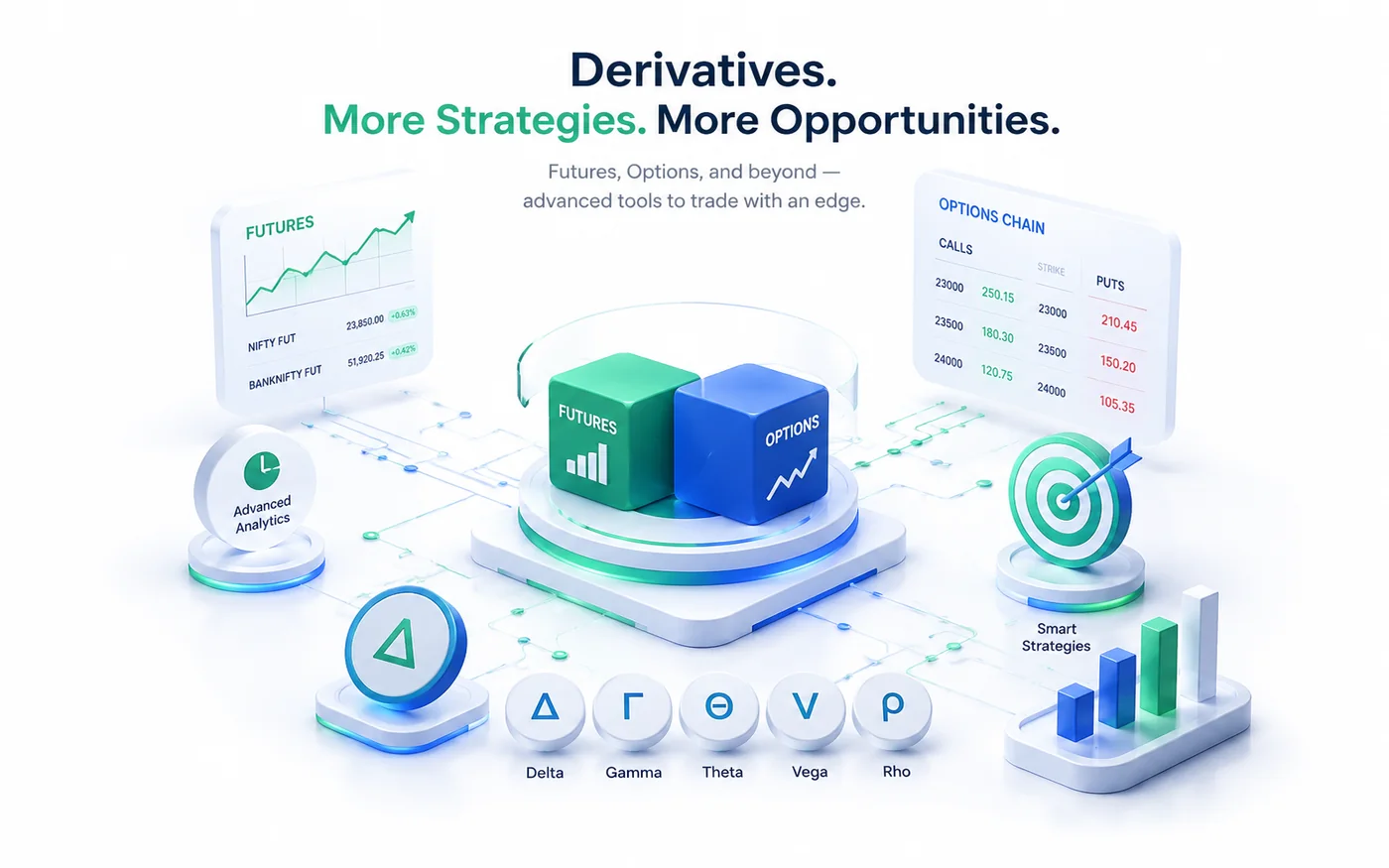
What are derivatives?
Understanding Derivatives
Derivatives help traders manage risk, capture opportunities, and make more informed decisions in every market condition.
Underlying Asset
The real asset whose price determines the value of a derivative — an index, a stock, a currency or a commodity.
Derivative Contract
The agreement itself: a future obligates both sides at a set price; an option gives the buyer a right, not an obligation.
Purpose
Manage risk, express a view, or generate income — with defined exposure and known cost up front.
Core analytics
Master the
Options Greeks
Understand how Delta, Gamma, Theta, Vega, and Rho influence every option you trade.
Delta
Confidently track price sensitivity and forecast trends.
Gamma
Shows how quickly Delta changes as the underlying price moves.
Theta
Know how time affects your trades, especially as expiry approaches.
Vega
Evaluate the impact of volatility before entering or adjusting positions.
Rho
Assess the effect of interest rates on longer-term option strategies.
How traders use derivatives
Multiple ways to trade. Multiple ways to win.
Directional Trading
Buy Calls if bullish, Puts if bearish, Futures for leverage.
Income Generation
Sell options to collect premium. Covered Calls, Cash-Secured Puts.
Hedging
Buy Puts as portfolio insurance against market crashes.
Spread Strategies
Bull Call Spreads, Bear Put Spreads, Iron Condors, Straddles.
Volatility Trading
Trade IV itself. Buy low IV, sell high IV using Quantxs analytics.
Leverage Opportunities
Unlock greater trading potential by controlling more with less capital.
Ready to Trade Smarter?
Open your free account today. Flat ₹20 brokerage from your very first trade.
FAQs
Questions? We have answers.
Financial contracts whose value derives from an underlying asset — index, stock, currency, or commodity.
Sensitivity measures: Delta (price), Gamma (acceleration), Theta (time decay), Vega (volatility), Rho (rates).
Market's expectation of future movement. High IV = expensive options. Quantxs tracks IV Percentile vs 1-year history.
Futures obligate both parties. Options give the buyer the right but not obligation — limited risk for buyers.